impact and charm
1953 Chevrolet Bel Air
- Year Production: 99,028 hardtop coupes (514,760 total Bel Airs)
- The car cost $1,741
- Transitional model between the Styleline and the radical second generation Bel Air designs
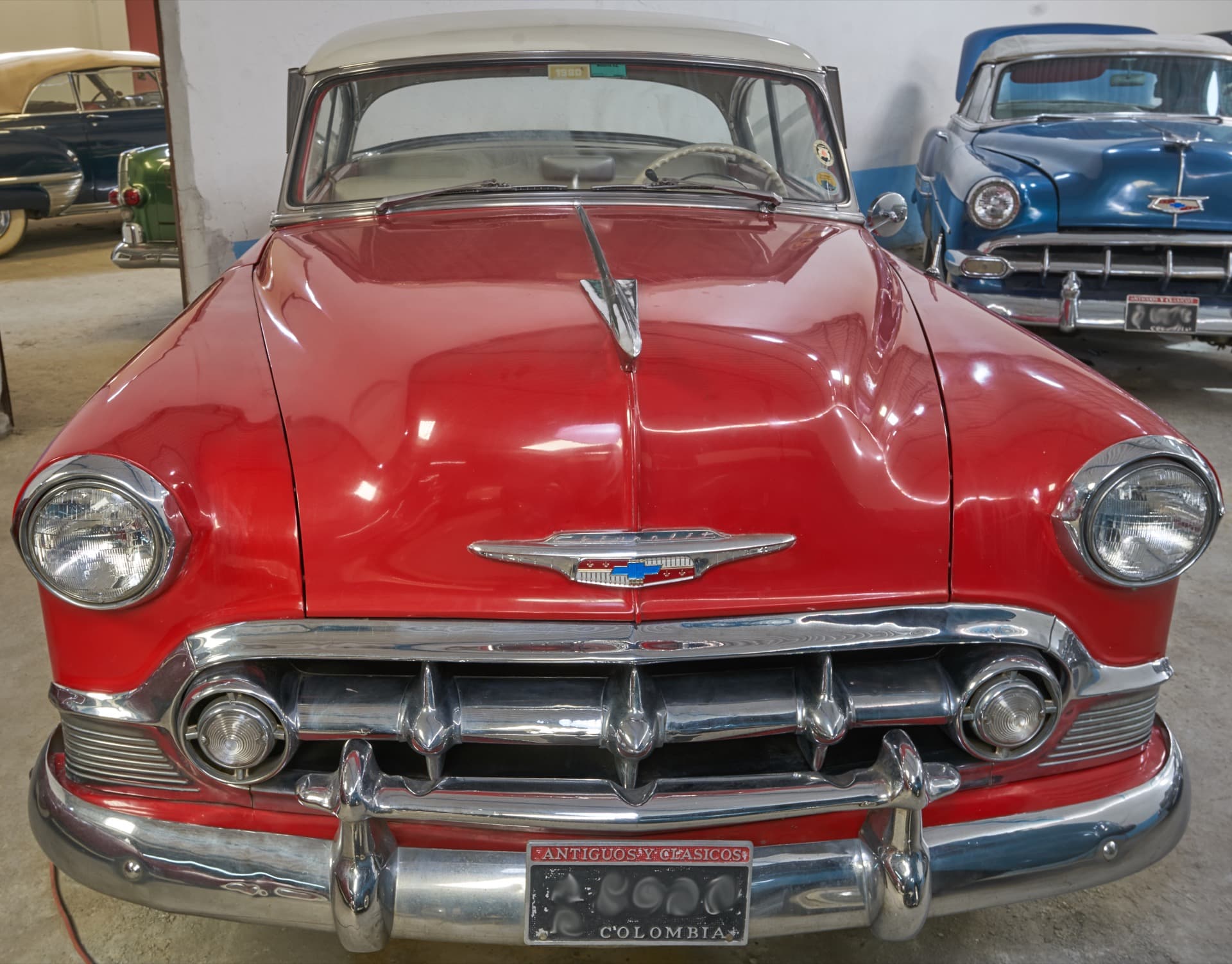
The Chevrolet Bel Air was produced for the 1950–1981 model years, however with the 1953 model year the Bel Air name was changed from a designation for a unique body shape to a premium level of trim applied across a number of body styles. Two lower series, the 150 and 210, also emerged (as successors to the Chevrolet Special and Deluxe series, respectively). The 1953 Chevrolet was advertised as "Entirely new through and through," due to the restyled body panels, front and rear ends. However, essentially the 1953 Chevrolet's had similar frame and mechanics as the 1949–1952 Chevrolets. The Bel Air continued with various other trim level designations until US production ceased in 1975. Production continued in Canada, for its home market only, through the 1981 model year.
The 1953–1954 Chevrolet range had a unique and arguably awkward look about it and much of this stemmed from its role as a transitional model to introduce a raft of changes that were necessary to pave the way for the introduction of the 1955–1957 range that cemented Bel Air as a cultural icon. Pre-war technology — such as torque tube drive, six-cylinder splash feed engines, knee action suspension, split windshields, etc. — was phased out and the foundations for the first post war modern Chevrolet passenger car were finalized in this 1953–1954 model.
Initially only the two door hardtops in the Chevrolet model range were designated with the Bel Air name from 1950 to 1952, as distinct from the Styleline and Fleetline models for the remainder of the range. For 1950, Chevrolet came up with a revolutionary style that would set a pattern for decades. The Bel Air Hardtop was styled as a convertible with a non-detachable solid roof. Models like this had been around since the 1920s, including early Chevrolets, with no degree of success. But the newly revised idea, sweeping the GM line from Chevrolet to Cadillac, had finally found its era.
Chevrolet introduced their first postwar design in 1949 and continued that iteration until 1952. At that point, nearly every other domestic manufacturer had fully incorporated postwar themes such as slab sides and lower ride heights, while Chevrolet was more reserved. Their trepidation with completely new designs didn't hurt sales, however, as the company was the most prolific producer during that timeframe. Even so, in order to draw even with Ford and Plymouth in the styling department, the 1953 Chevrolets were all new. Fender protrusions shrunk, as did heights. The 235-c.i. engine gained aluminum pistons and full-pressure lubrication, and became the sole displacement size available across the brand. Also, all new model names were introduced, with the 150, 210, and Bel Air. The 150 was the bare-bones model with little chrome trim and rubber mats, the 210 was the intermediate, with some brightwork and the Bel Air was fully trimmed, with two-tone interior and carpet. The windshield was curved and one-piece, the grille was bolder and oval, with turn signals in the corners, and the front fender line flowed through, with side trim and a contrasting roof and side-flash in the top-line Bel Air. The new models were significantly more attractive than their predecessors, with bright colors and superior trim, especially in the Bel Air. 1954 would be the last evolution of the 1949 body style, as 1955 would break the mold with a classically clean form and the new V-8.
Exterior
- •Side windows without frames, allowing the Bel Air to be termed a convertible with a non-detachable solid roof
- •Unique three piece rear window gave it a longer and more balanced look
- •Wheelbase: 115.0 in.
- •Weight: 3,230–3,540 lbs
Interior
- •Bel Air interiors had an optional massive expanse of chrome across the lower part of the dashboard (most were painted), along with a deluxe Bel Air steering wheel with full chrome horn ring. Carpeting and full wheel covers rounded out Bel Air standard equipment.
- •Cloth Upholstery and Vinyl Interior
- •Chrome glove compartment
Mechanical
- •OHV I-6, 235.5 cid (3.56 x 3.94) 105/115 bhp
- •Transmission: 3-speed manual; 2-speed Powerglide optional
- •Suspension, front: upper and lower A-arms, coil springs
- •Suspension, rear: live axle, semi-elliptic leaf springs
- •Brakes: front/rear drums